
Nick Milau
November 12, 2026
Weekly Wrap
Global markets remained resilient this week in the face of the still unfolding Huang/Nvidia scandal. While Nvidia shares fell 15% this week (less than I would have thought to be fair) the rest of the tech sector held its own. Canadian stocks rose 0.25%, held back by gold stocks that were dragged down by the 4-5% drop in gold prices. US stocks were up over 1.5% in fairly broad-based, ex-Nvidia, strength. Oil prices settled down as a chastened Trump explores deals and/or economic sanctions on Iran as opposed to military intervention. The developed international markets and the emerging markets both gained 2%, likely on oil price relief hope. Trump is likely to face a lot of pressure to relent on his trade war with Canada, and others, while Carney extended tariff exemptions on certain US products, perhaps paving the way to resolving trade issues. Interest rates jumped around 0.25% as US inflation data came in hot and Fed governors ponders jumbo rate hikes.
Market Insights
Brewing troubles in the massive financing of the AI pipeline. This week’s very public demise of Jensen Huang has brought the tenuous manner in which AI is being financed to the attention of the world. Investors, a salivating media and a new, Democrat-controlled Washington DC are ready to pounce. While most are focusing on the lewd details of Huang’s affairs, investors should be more concerned with the following:
- The abundantly clear conflicts of interest between elected officials and AI executives
- The likelihood that said conflicts will be under the microscope by newly anointed Democratic Senators and Congress members
- The growing investor distaste for excessive AI capex – companies that are increasing spending are seeing share prices fall
- The increasing reluctance of conventional lenders to finance AI related debt – spreads are widening for borrowers in this sector
- The questionable alternative financing arrangements of AI companies
- The incestuous relationship of AI companies
The last two points are the ones that deserve more consideration. Two examples of alternative financing for AI are circular financing and SPVs (special purpose vehicles). Nvidia, who has enough problems to navigate this week, is the key circular financier of AI. Many of NVDA’s customers don’t have the cash to buy their chips, so NVDA offers to sell them in return for equity stakes in their customers (which usually come with long-term commitments to buy NVDA chips). Then, the customer turns to other credit providers and, using their new chips as collateral, buys MORE chips from NVDA. NVDA then offers long-term commitments to buy said customers’ products in return. If you’re confused, I don’t blame you! Estimates of NVDA’s circular financing put it at around $1 trillion…and they are not the only company doing this. In the 1990’s the telecom industry engaged in similar practices; what followed were bankruptcies of those telecom companies (and some of their accountants who did their books), steep losses in stock prices for the sector and even jail time for some executives. And all of this happened without alleged Chinese spies or sex scandals!!
This week, our fixed income department put out an interesting piece on the explosive growth in SPVs to finance AI, particularly data centers. Special Purpose Vehicles are off -balance-sheet entities used to finance things a company does not want to carry on their balance sheet. Take the financing of Meta’s Hyperion Campus for example. Meta needed $30 billion to build a massive data-center campus, but it does not want that debt on its balance sheet. So instead of borrowing the money itself (and they are already borrowing a lot of money on their balance sheet by the way), it created an SPV alongside Blue Owl that owns and finances the data center (Meta owns 20% of it and Blue Owl 80%). The SPV then goes and borrows $26 billion from PIMCO, making PIMCO the Senior Secured private credit lender to the SPV, with the loan secured by the data center assets and cash flows: Meta becomes the tenant. Basically, Blue Owl built the thing (SPV), Meta filled it with rent payments, and PIMCO funded the whole thing sitting at the top of the waterfall, secured against everything inside the thing. According to our fixed income department, this SPV market is now about $4.5 Trillion!
In addition to the concerns about the scale of these questionable ventures, you can see the growing, incestuous relationship between those in the AI supply chain and, as such, their success, or perhaps their survival, looks increasingly interdependent. If AI is able to cross the divide and offer the public a profitable business model, then all of this will be fine; debts will be repaid, AI will do what it is supposed to do and the only thing we will have to worry about will be the potential end of humanity! But John Keynes had a great saying about debt; the market can remain irrational longer than you can remain solvent. Right now, the AI market is irrational and for creditors in this space they better hope they can remain solvent for as long as the AI market remains irrational.
Portfolio Update
No changes were made to portfolios this week. Although there are likely some profits to be taken (some in preferred shares for example), as we approach year end, we are likely to defer such profit taking until early 2027 in order to spread out and defer capital gains. Interestingly, with interest rates still gyrating up and down the preferreds provide some ballast to the fixed income side of the portfolio: when interest rates rise, bond prices fall but preferred share prices tend to either remain constant or rise. This is due to the fact that rate reset preferred share dividend yields are adjusted every 5 years up or down with current interest rate levels. Thus, when rates go up investors buy preferreds in anticipation of rising yields. Nevertheless, we expect to slowly draw down our preferred shares over the coming months.
Please note any changes apply to our Private Investment Management (PIM) portfolios only, subject to restrictions. Please call to clarify if you have any questions.
Planning On
Budget 2026 – Masters of our Destiny
The Federal government tabled Budget 2026 on November 5th. Rather than trying to explain everything, we have included the link below to read either all of it or the sections that may apply to you. However, there are a few things of note that we have detailed below.
On the personal side, the RRSP for Life is the most interesting. Under current legislation, by the end of the year in which one turns 71, an RRSP must be converted to a Registered Retirement Income Fund (RRIF) and then minimum payments must begin. The budget proposes to eliminate the need to open a new account and transfer the RRSP balance over. In this new system, payments would just begin from the existing RRSP account with no need to convert to a RRIF. Additionally, right now a spouse or common-law partner can only be a beneficiary on an RRSP, and the budget proposes to allow the successor holder option for a simpler, direct tax-free transfer on death. The proposed increase of the instalment threshold from $3,000 to $7,500 (indexed to inflation) for individuals outside of Quebec is also welcome news.
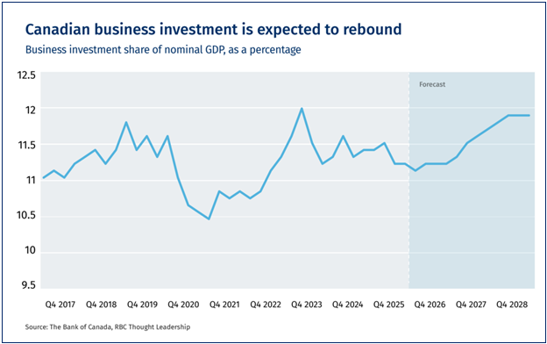
On the investment and business side, the budget proposes a new capital gains incentive allowing founders, key employees and external investors to exempt up to $15 million in capital gains in some situations. The Productivity Mega Deduction (previously announced) proposes to cut the marginal effective tax rate on new business investment from 13% to 6.4%.
Remember that these are just proposals as of now and are not enacted into law although because the Liberal government has a majority it is likely that these will pass.
Federal budget 2026: An overview of key measures that may impact you
This information is not intended to provide legal, tax, or insurance advice. To ensure that your own circumstances have been properly considered and that action is taken based on the latest information available, you should obtain professional advice from a qualified lawyer or accountant, as applicable, before acting on any of the information.
Charts of the Week
Feel free to share this newsletter with anyone who might benefit from it or find value in it. Thank you for reading our commentary. We welcome your feedback!
Return to homepage
This information is not investment advice and should be used only in conjunction with a discussion with your RBC Dominion Securities Inc. Investment Advisor. This will ensure that your own circumstances have been considered properly and that any action is taken based upon the latest available information. The strategies and advice in this report are provided for general guidance. Readers should consult their own Investment Advisor when planning to implement a strategy. Interest rates, market conditions, special offers, tax rulings, and other investment factors are subject to change. The information contained herein has been obtained from sources believed to be reliable at the time obtained but neither RBC Dominion Securities Inc. nor its employees, agents, or information suppliers can guarantee its accuracy or completeness. This report is not and under no circumstances is to be construed as an offer to sell or the solicitation of an offer to buy any securities. This report is furnished on the basis and understanding that neither RBC Dominion Securities Inc. nor its employees, agents, or information suppliers is to be under any responsibility or liability whatsoever in respect thereof. The inventories of RBC Dominion Securities Inc. may from time to time include securities mentioned herein. This publication is for information purposes only. Graphs and charts are used for illustrative purposes only and do not reflect future values or changes. Past performance is not indicative of future returns. This commentary is based on information that is believed to be accurate at the time of writing and is subject to change. All opinions and estimates contained in this report constitute RBC Dominion Securities Inc.'s judgment as of the date of this report, are subject to change without notice and are provided in good faith but without legal responsibility. Interest rates, market conditions and other investment factors are subject to change. Past performance may not be repeated. The information provided is intended only to illustrate certain historical returns and is not intended to reflect future values or returns. This publication is not intended as nor does it constitute tax or legal advice. Readers should consult their own lawyer, accountant or other professional advisor when planning to implement a strategy. Insurance products are offered through RBC Wealth Management Financial Services Inc.("RBC WMFS"), a subsidiary of RBC Dominion Securities Inc.* RBC WMFS is licensed as a financial services firm in the province of Quebec. When providing insurance products in all provinces except Quebec, Investment Advisors are acting as Insurance Representatives of RBC WMFS. In Quebec, Investment Advisors and Estate Planning Specialists are acting as Financial Security Advisors of RBC WMFS. RBC Dominion Securities Inc., RBC WMFS and Royal Bank of Canada are separate corporate entities which are affiliated. *Member-Canadian Investor Protection Fund. RBC Dominion Securities Inc. and RBC WMFS are member companies of RBC Wealth Management, a business segment of Royal Bank of Canada. â / ™ Trademark(s) of Royal Bank of Canada. Used under license. RBC Dominion Securities Inc. 2026 All rights reserved.